Call and alerting system questions, answered from your manuals.
Nurse call, disabled refuge, accessible toilet alarms and deaf alerting: the answers installers ring about are already in your manuals. Lingo drafts guides from them, your technical team checks and publishes them, and the installer on site gets the steps for the system in front of them, at any hour.


Lingo
Online


Pager silent at the fire alarm test
PublishedQUESTION
Did the transmitter’s transmit light come on during the test?
ANSWERS
- 1.Yes, it lit
- 2.No
FIX
1. Check the pager is out of its charger: on this system pagers do not alert while charging. 2. Check the pager’s in-range light. If it is off, the pager has missed the system’s test calls. 3. Run the system test from the transmitter and watch the pager. 4. Still silent? Ask for a person.
The questions come from all over the building.
A hotel or an office block can have a refuge on every stair landing, an alarm in each accessible toilet, a call system in some rooms and pagers for people who are deaf. Several of them take a signal from the fire panel. Each comes with its own manuals.
Deaf and hard-of-hearing alerting
“The pager didn’t go off when we tested the fire alarm.”
Whether the transmitter saw the fire signal, then charger, battery and coverage, as your manual lists them.
Disabled refuges
“Outstation 4 is showing a line fault.”
Termination at each end of the ring, loop voltage and addressing, then the span and ring limits for that cable.
Accessible toilet alarms
“The alarm won’t cancel from the controller outside.”
Where that kit can be reset. On one kit, only at the reset point inside the toilet.
Nurse call
“The overdoor light is flashing red and green.”
What that light pattern means on this system, and where that call type can be reset.
The fire panel
“Which output should the paging transmitter take?”
Interfaces and cause and effect go to your team.
When a pager stays silent at the fire alarm test.
RNID says 2.4 million people in the UK have hearing loss that means they would struggle to hear most conversational speech. Where a building gives them a pager or a vibrating pad, that is how the fire alarm reaches them. The manuals give four reasons a pager stays silent, and a guide checks them in order.
Pager silent at the fire alarm test
Guide check 1
In its charger
One user guide: pagers “do not operate whilst being charged in the rack”.
Guide check 2
Battery low
One maker’s pagers vibrate to warn of a low battery, citing BS 5839-1.
Guide check 3
Out of coverage
One system vibrates a pager “within two minutes” of it leaving coverage, then every 15 minutes until it is back.
Your team
No fire signal at the transmitter
The transmit light stayed off. The fire panel interface is a question for your team.
Source: RNID, deafness and hearing loss prevalence, updated 21 October 2026.
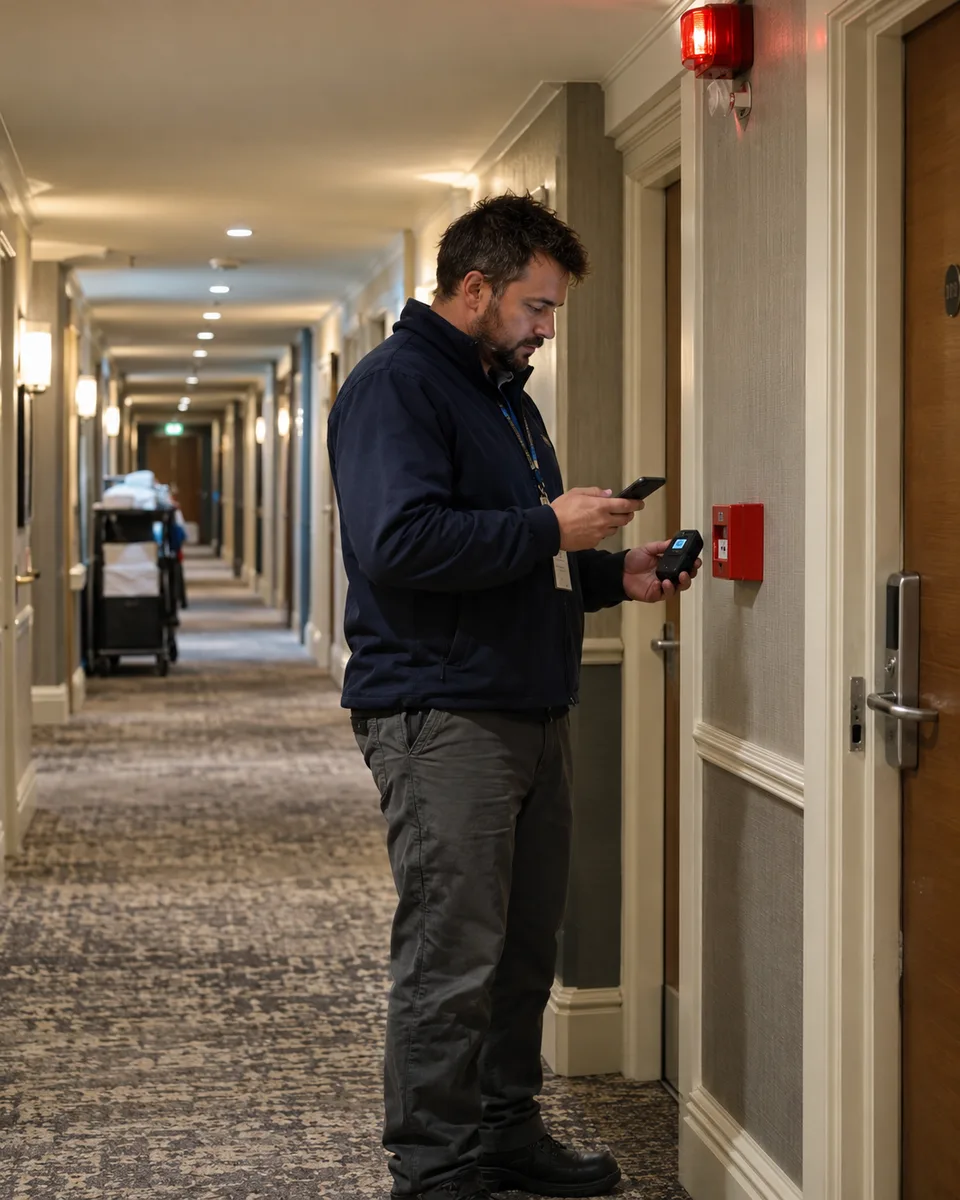
At the fire alarm test
The installer checks the pager against the steps on his phone while the alarm is still sounding.
On one refuge system, the ring gets longer, then shorter, as units are added.
The installation manual gives a maximum ring length for each number of remote units. It peaks at 2,500 m with 12 units and falls to 475 m with 32. An installer asking how far they can run the cable needs the row for their system.
Maximum ring length, by remote units on the ring
Remote units on the ring
200 m
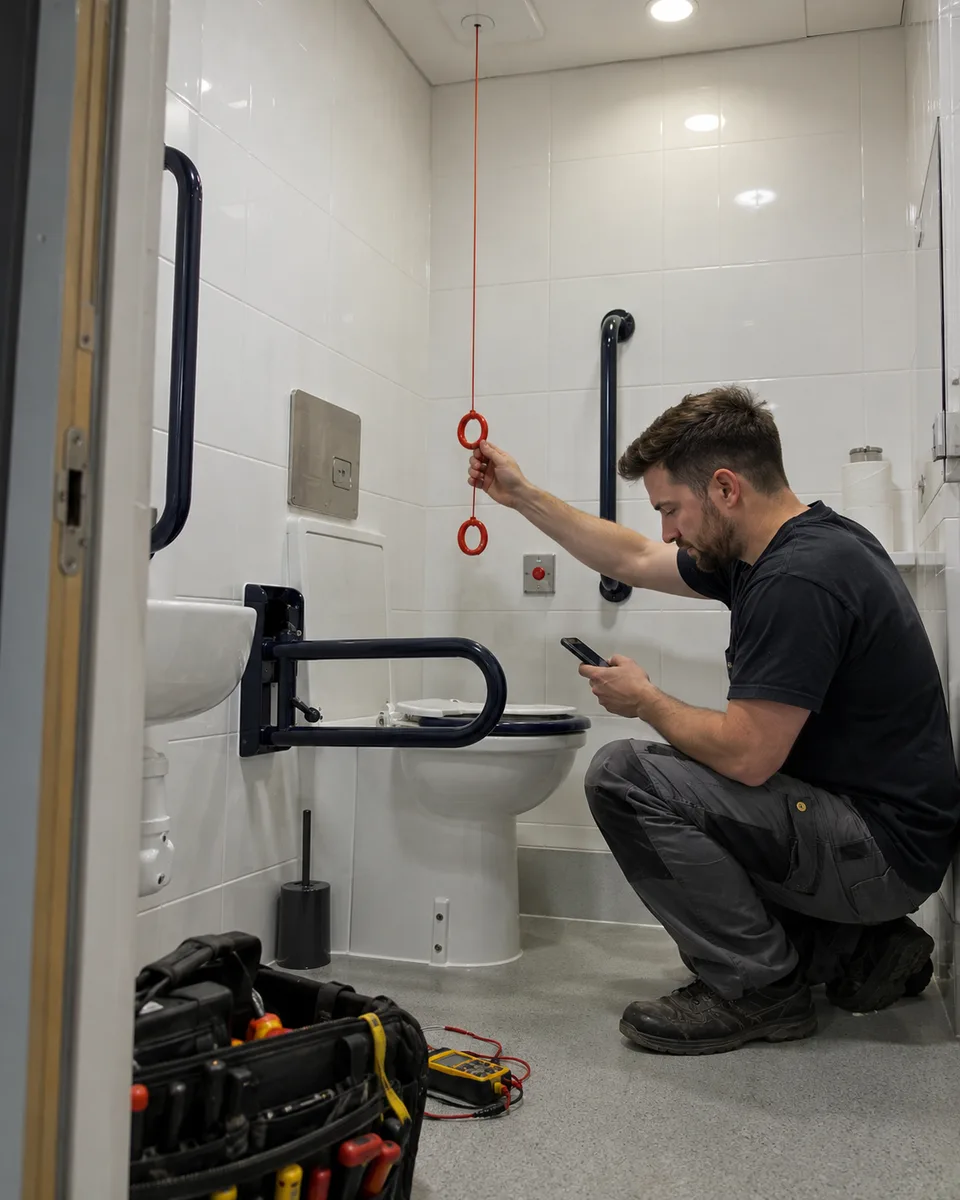
between units, at most, with the cable the same refuge manual recommends
120 s
before an acknowledged toilet alarm call returns on one kit, until it is reset inside the toilet
24 h
of standby on another toilet alarm kit’s battery, with 15 minutes of alarm
Anything that changes the fire alarm goes to your team.
Several of these systems take a signal from the fire panel, and some report faults back to it. One paging transmitter has prioritised fire inputs and a fault relay to the panel. One refuge system includes “a fault relay for indication at the fire panel”.
Your technical team keeps
- The fire panel interface: fire inputs, fault relays and how each system reports back
- Cause and effect, which the site’s fire strategy sets
- Silencing, disabling or isolating any part of the fire alarm
- Where pagers and beacons go, and coverage surveys
- New battery calculations when units are added after handover
A guide covers
- What a light pattern, a panel message or a fault indication means
- Whether the transmitter or panel received the fire signal, as your manual shows it
- Pager charging, battery and coverage checks
- Cable, span and ring limits, termination and addressing
- Reset rules for each call type
It is not the responsibility of the Fire Alarm Designer to specify the C&E programme for the premises, that is determined from the Fire Strategy/Fire Risk Assessment.
BS 5839-9
Refuges. Approved Document B says refuges should have an EVC system complying with BS 5839-9, with Type B outstations.
SourceBS 5839-1
Deaf alerting in buildings. Approved Document B points to clause 18 for warnings for people with impaired hearing. The 2025 edition has a normative annex on control and transmission equipment for portable tactile alarm devices.
SourceBS 5446-3
Deaf alerting at home. Fire and carbon monoxide alarm systems for deaf and hard-of-hearing people in dwellings, including vibrating and visual devices.
Source
What it takes to start.
- 1
Send the documents for one product
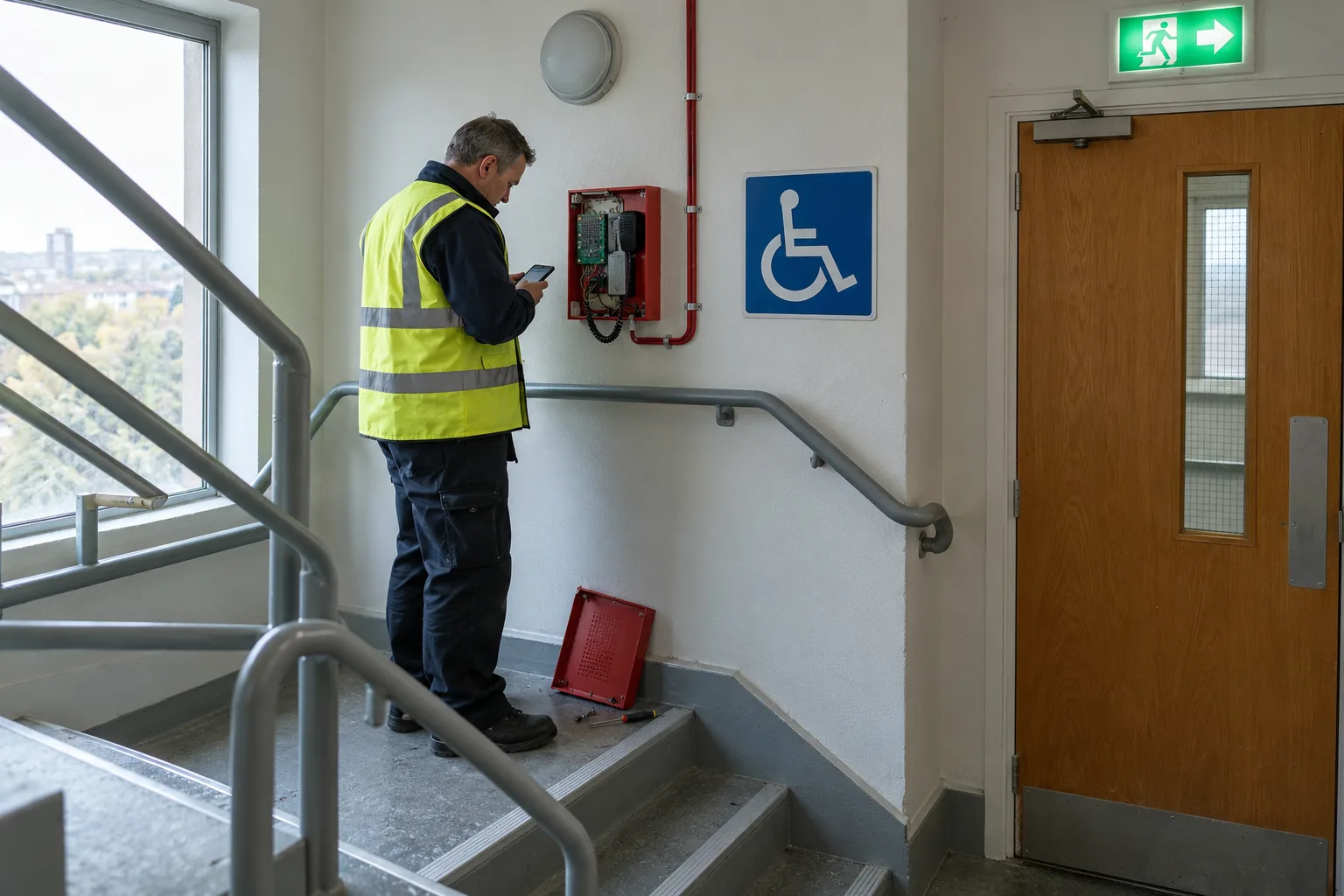
One system’s installation and commissioning manual, its programming guide, and the data sheets for the devices that go with it.
- 2
See your own draft guides
Lingo drafts a guide for each task. We go through the drafts with you in a 15-minute walkthrough.
- 3
Your team checks and publishes
Checking each draft against the manual is the main work. Your team corrects it and publishes it, and can edit or unpublish it at any time.
- 4
Start with people you choose
Approve the installers at two or three contractors first. Each conversation is kept with the system and the guide used.
Questions call and alerting system manufacturers ask
We make nurse call, refuge, toilet alarm and deaf alerting systems. Does one setup cover them all?
Yes. Each system has its own guides, priced by the number of products you support. A guide asks which system and which call or alarm type before it sends a step.
We make fire panels as well as a call range. Can both go into Lingo?
Yes. Each product has its own guides, so your fire panels, call systems and alerting products can sit in one account, priced by the number of products you support. Questions about how they connect, such as interfaces and cause and effect, can go straight to your team.
Can it cover panels and kits we no longer sell?
Yes, where the documents exist. Each product has its own guides, and a guide asks which generation or variant is fitted.
Who can use it?
The installers and contractors you approve, by phone number. You can start with a few contractors and add more as a list.
Who checks the guides?
Your technical team. Lingo drafts each guide from your documents; your team checks it against the source, corrects it and publishes it, and can edit or unpublish it at any time. Every conversation is kept with the installer, the system and the guide used.
What happens when an installer asks something no guide covers?
The installer can ask for a person at any point. Your team is notified by email and replies in the same conversation, in the hours you set. They can then add the answer to a guide.
How is it priced?
By the number of products you support, from £500 a month for five products. There is no setup fee, and no limit on installers or conversations.
Related use cases
Use case
Wiring and connections
The documented connection steps for the accessory and variant fitted.
More on wiring and connectionsUse case
Fault codes
The manual’s checks for a fault indication, then a handover to your team.
More on fault codesUse case
Commissioning and setup
Your commissioning procedure as ordered questions and steps.
More on commissioning and setup
Further reading
Article
How Lingo turns a manual into a guide
Read the articlePricing
Priced by the number of products you support
See pricing
Sources, read 22 and 23 October 2026: installation manuals and data sheets from UK makers of fire paging systems for deaf and hard-of-hearing people (two makers, issues dated 2017 to 2019) and a pager user guide; installation manuals, kit guides and data sheets from UK makers of refuge, toilet alarm and nurse call systems (issues dated 2008 to 2026); RNID, Deafness and hearing loss prevalence; Approved Document B, Volume 2; FIA, Guide to the changes in BS 5839-1:2025; FIA, Guidance for BS 7273-6; IET, Wiring Matters on BS 5839-1:2025; BSI, BS 5446-3:2015.
Send us one system’s manuals.
We’ll convert them and show you your own guide in a 15-minute walkthrough.