Fault-finding and commissioning guides your engineers have approved.
Trained engineers still ring the technical line about an indication, a commissioning stage or the service routine for one system. Lingo turns your panel and system manuals into guides your technical team checks and publishes, for the engineers you approve. Release-circuit and design questions go to your team.


Lingo
Online


A fault indication on the panel
PublishedQUESTION
What does the fault relate to?
ANSWERS
- 1.Power supply or battery
- 2.A detection zone
- 3.The release circuit
FIX
From the guide your team published for this panel: 1. Mains supply checks 2. Battery and connection checks 3. Charger checks 4. Confirm the indication has cleared
At a life-safety panel, the engineer gets the procedure your team approved.
What an engineer is told at the panel should be what your manual says, checked by your technical team.
- 1
Drafted from your manual
You send the installation, commissioning and maintenance manuals for a product. Lingo drafts a guide for each task as a short sequence of questions and steps.
- 2
Checked and published by your engineers
Your technical team checks every draft against the manual, corrects it and publishes it.
- 3
Changed when you change it
Your team can edit or unpublish a guide at any time.

A fault at the panel, start to finish.
- 1
Confirms the product
Each panel and system has its own guides, so the engineer gets the procedure written for the one fitted.
- 2
Sends the published checks
For a power supply or detection zone fault, the next message is the checks from the guide your team published, in your manual’s order.
- 3
Hands the release circuit to your engineers
Where your team has decided a question needs a person, the guide passes the conversation to them. They reply in it during your opening hours.
Lingo
Online
Passed to the technical team
Indications, commissioning, servicing and variants.
Fault and status indications
What an indication on the panel or status unit means, and the checks your manual lists for it.
Commissioning and handover
The commissioning sequence for a system, one stage at a time, through to the checks you require before handover.
Service and maintenance
The routine your manual sets for each service visit, for the product in front of the engineer.
The right procedure for the variant
For extinguishant control panels, detection and release control, and kitchen, vehicle and local-application systems.
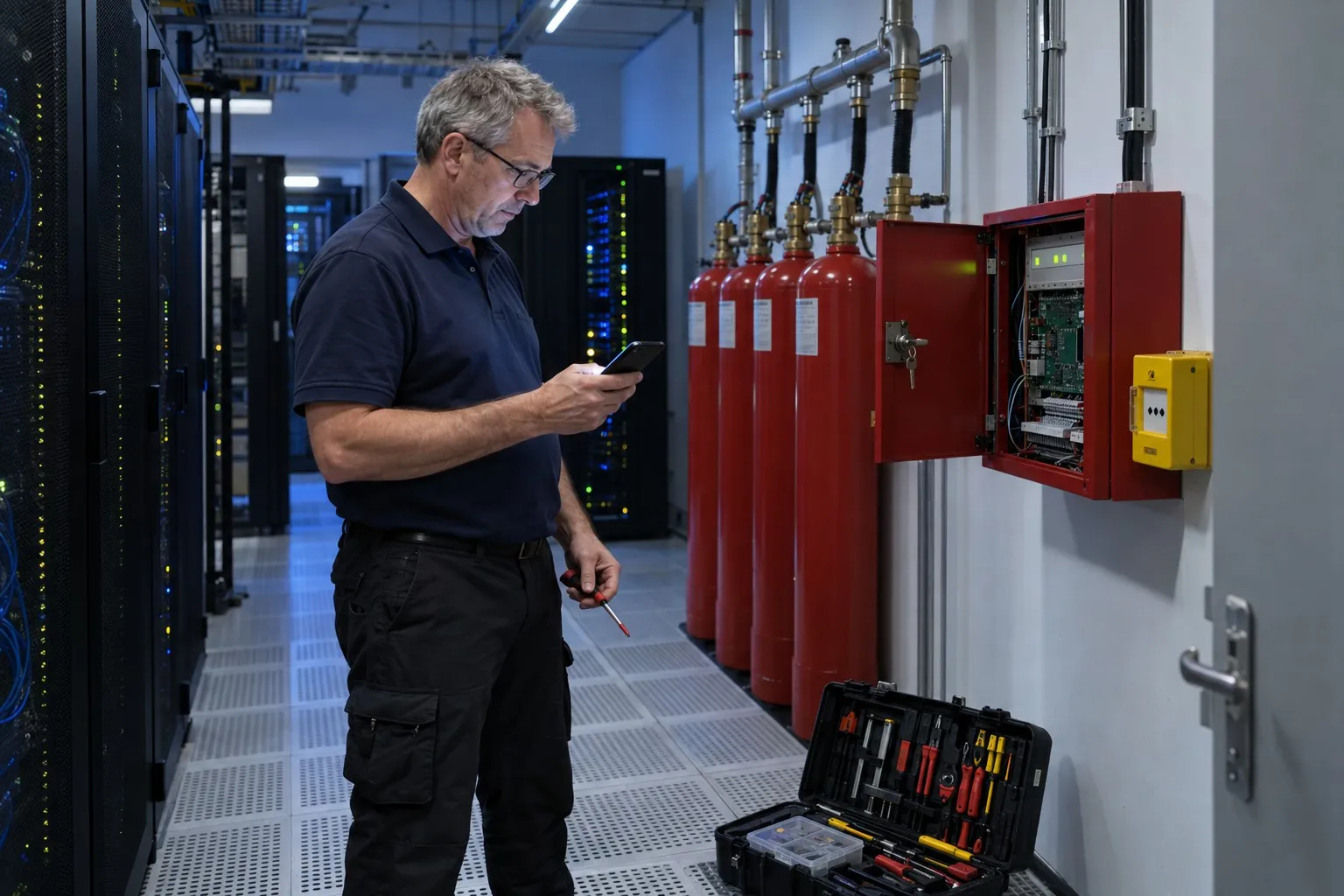
Your team decides where a guide stops.
The manuals we read restrict installation and maintenance to trained personnel. A guide carries the documented procedures your team chooses, and passes the rest to them.
A published guide can take
- What a fault or status indication means, and the checks your manual lists for it
- Commissioning stages, through to your handover checks
- The service routine for the product fitted
- Which procedure applies to the panel or system variant
Your technical team keeps
Release circuit and isolation
Sequences differ between makers, and one panel manual requires “appropriate isolation measures” before any testing. Your team decides whether a guide covers them at all.
Site design
Cause and effect, delays and agent quantity are set for each site. One system maker states it “does not design systems for specific installations”.
Work your manuals restrict
An approved number identifies a phone, not a certificate. Work your manuals reserve for trained or F-gas certificated engineers stays with them.
A fault that comes back
An indication that returns after the published checks goes to your team.
Only the engineers you approve.
Engineers you approve by phone number
Engineered-system makers already keep technical information for trained, authorised distributors. Approve their engineers’ numbers, one at a time or as an imported list, and only they can use your guides.
Your hours for people
Guides answer at any hour. A request for a person reaches your team by email in the opening hours you set; outside them the engineer gets your out-of-hours message.
A record of every conversation
Each one is kept with the engineer’s name and number, the product and the guide used.
What it takes to start.
- 1
Send the documents for one product
The installation, commissioning and maintenance manuals for one panel or system, with any technical bulletins.
- 2
See your own draft guides
Lingo drafts a guide for each task. We go through the drafts with you in a 15-minute walkthrough.
- 3
Your team checks and publishes
Checking each draft against the manual is the main work. Your team corrects it and publishes it, and can edit or unpublish it at any time.
- 4
Start with people you choose
Approve the numbers of a first group of trained engineers, such as one distributor’s service team.
Questions fire suppression manufacturers ask
We already have a distributor portal and a training programme. What does Lingo add?
The portal holds the manuals and the training qualifies the engineer. Lingo handles the question that comes up at the panel afterwards: it asks which product is fitted, sends the checks from the guide your team published, and passes the conversation to your technical team when the guide or the engineer asks for a person.
What happens to a question no guide covers?
The engineer can ask for a person at any point. Your technical team replies in the same conversation in your opening hours, and can then add the answer to the guide by editing it.
Can it cover panels and systems we no longer sell?
Yes, where the manuals exist. Each product has its own guides, and the engineer is asked which product they have.
Does an approved phone number prove the engineer is qualified?
No. It identifies the phone. Your team decides whose numbers to approve, and keeps restricted work out of the guides.
How is it priced?
By the number of products you support, from £500 a month for five products. There is no setup fee and no limit on the number of engineers or conversations.
Related use cases
Use case
Commissioning and setup
Your commissioning procedure as ordered questions and steps.
More on commissioning and setupUse case
Fault codes
The manual’s checks for a fault indication, then a handover to your team.
More on fault codesUse case
Out-of-hours support
Published guides answer at any hour. Your team answers in the hours you set.
More on out-of-hours support
Further reading
Article
How Lingo turns a manual into a guide
Read the articlePricing
Priced by the number of products you support
See pricing
Sources, read 8 October 2026: installation, commissioning and maintenance manuals from four manufacturers of extinguishant control panels and suppression systems; the published support pages of panel and system makers.
Send us one panel manual.
We’ll convert it and show you your own guide in a 15-minute walkthrough.