For technical support and aftersales leaders choosing a supplier
Twelve questions to ask before you buy AI for technical support
Every demonstration looks good. What decides whether a system is safe in front of installers is how it behaves at the edges. A checklist for manufacturers, with what a good answer sounds like and what should make you wary.

Lingo
6 min read
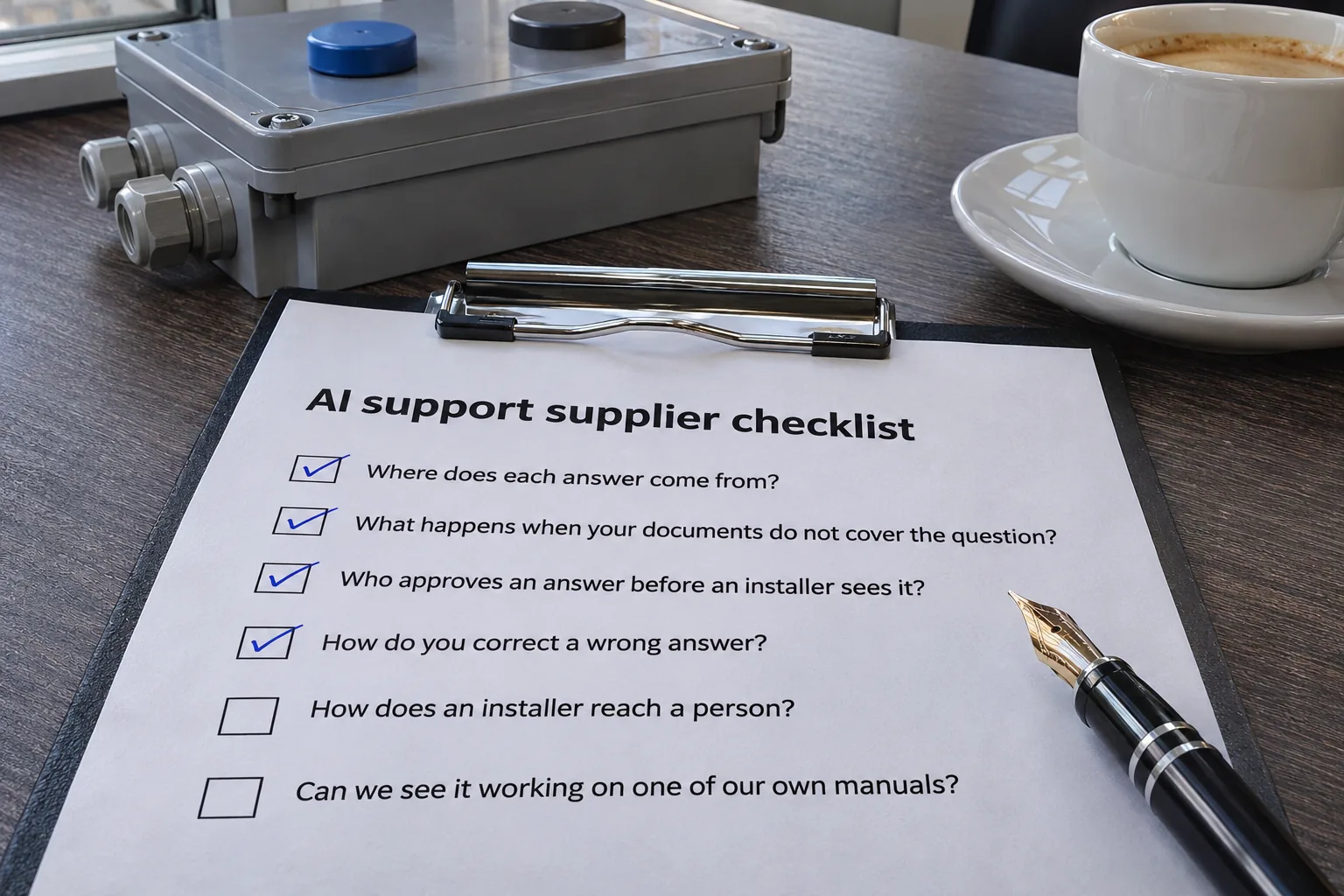
Every supplier of AI support now promises fast, accurate answers, and every demonstration looks good. What decides whether a system is safe to put in front of your installers is how it behaves at the edges: when the manual does not cover the question, when an answer turns out to be wrong, when an installer needs a person at seven in the evening. Twelve plain questions find those edges. Here they are, with what a good answer sounds like and what should make you wary.
In short
- Ask where every answer comes from, and what happens when your documents do not cover the question. A good system says so and passes the question to a person.
- Your technical team should approve what installers are told, correct it themselves, and be able to keep any procedure out entirely.
- Score the supplier on one of your own manuals before you sign. Tick a question only when you have seen the answer, not just heard it.
How to use the checklist
Use it in the demonstration, not in a written questionnaire. On paper, every supplier’s answer to “where do your answers come from?” sounds alike. Watching the system handle a question your manual does not cover is harder to fake. Send the supplier one of your own manuals beforehand, bring the person who answers your technical line, and tick each question below only when you have seen the answer working.
The twelve questions
Where the answer comes from
- A good answer
- From documents you supplied, turned into steps your team approved.
- Watch for
- “The model knows the subject” or “it learned from the web”.
- A good answer
- It says so and passes the question to a person, with the conversation attached.
- Watch for
- A confident answer anyway.
- A good answer
- It asks, and the answer decides which steps follow.
- Watch for
- One answer for a whole product family.
Who controls it
- A good answer
- Someone on your technical team, before it is published.
- Watch for
- Answers go live as soon as the documents are uploaded.
- A good answer
- Your team edits the step or unpublishes it, and the next installer gets the corrected version.
- Watch for
- A support ticket to the supplier, or waiting for the model to be retrained.
- A good answer
- Yes. A procedure can be left out, or can end by passing the installer to your team.
- Watch for
- Everything uploaded is fair game.
When a person is needed
- A good answer
- At any point, in the same conversation. Your team is told and sees the earlier messages.
- Watch for
- The installer has to start again on the phone.
- A good answer
- Published guides keep answering. A request for a person gets your out-of-hours message and waits for the hours you set.
- Watch for
- Requests that sit in a queue nobody can see.
- A good answer
- The supplier knows a business can reply freely for 24 hours after the installer’s last message, and shows you how a late reply from your team is sent.
- Watch for
- They have not heard of the rule.
Records, access and proof
- A good answer
- Phone numbers you approve. Each conversation is kept with the person, the product and the guide used.
- Watch for
- Anyone with the number, and only totals in a dashboard.
- A good answer
- Yes, both, before any installer’s details are processed.
- Watch for
- A privacy policy offered in place of a contract.
- A good answer
- Yes: draft guides built from a manual you send, shown to your team.
- Watch for
- A demonstration on the supplier’s sample content only.
0 of 12 answered well
Tick each question the supplier answered well.

Why the edges matter more than the demo
In February 2024 a Canadian tribunal decided Moffatt v. Air Canada. The airline’s website chatbot had described a refund policy wrongly, and the airline argued it was not responsible for what the chatbot said. The tribunal held Air Canada responsible for all the information on its website, chatbot included. A manufacturer is in the same position with whatever its support system tells an installer, so the first two questions carry the most weight. Our article on deterministic and generative AI covers the difference in design behind them.
A supplier who cannot say what happens when the manual has no answer has not decided. The model will decide for them.
The WhatsApp question sounds technical, and it is practical. A business on the WhatsApp platform can reply freely for 24 hours after a person’s last message. After that, as Twilio’s documentation puts it, a business “may only send a message using an approved template”. If an installer asks for a person at six on a Friday and your team picks it up on Monday, the supplier should be able to show you exactly how that reply reaches him.
The data question is a legal requirement in the UK, not a courtesy. The Information Commissioner’s Office says that whenever a controller uses a processor, “a written contract needs to be in place”, and that a processor may not use a sub-processor without the controller’s “prior specific or general written authorisation”. Installers’ names and numbers are personal data, so ask for the contract and the list of sub-processors before the first conversation, not after.
Start with one manual
The last question is the one that settles the others. Choose the product your technical line hears about most, send that manual, and ask for draft guides built from it. Have the person who answers the phone check the drafts against the manual, and try the questions installers actually ask, including one the manual does not cover. If you want a baseline first, our method for measuring how much of your support is repetitive takes a week.

We built Lingo around these questions. Guides are drafted from your documents, and your technical team checks and publishes each one. The installer is asked which product he has before a step is sent, and he can ask for a person at any point. Access is limited to the numbers you approve, and every conversation is kept with the product and the guide used. Put the twelve questions to us, with one of your own manuals.
Sources
- Moffatt v. Air Canada, 2024 BCCRT 149British Columbia Civil Resolution Tribunal, 14 February 2024.
- Key concepts and terms for the WhatsApp Business PlatformTwilio, read 9 November 2026. The customer service window.
- ContractsInformation Commissioner’s Office, updated 19 May 2023.
Questions people ask
What should a manufacturer ask before buying AI for technical support?
Where each answer comes from, what happens when your documents do not cover a question, who approves what installers are told, how a wrong answer is corrected, how an installer reaches a person, who can use the service, what is recorded, and whether the supplier will sign a data processing contract and name its sub-processors. Ask to see the answers on one of your own manuals before you sign.
Is a company responsible for what its AI support tells customers?
A Canadian tribunal decided that it is. In Moffatt v. Air Canada (February 2024) the airline was held responsible for a refund policy its website chatbot had described wrongly, and ordered to pay the customer damages.
Does an AI support supplier need a data processing contract?
In the UK, yes, if it processes personal data on your behalf. The Information Commissioner’s Office says that whenever a controller uses a processor, a written contract needs to be in place, and that a processor may not engage a sub-processor without the controller’s prior specific or general written authorisation.